〈interview〉
Leather That Suits Them.
— A Quiet Sense of Occasion: The Key Merge Wallet —
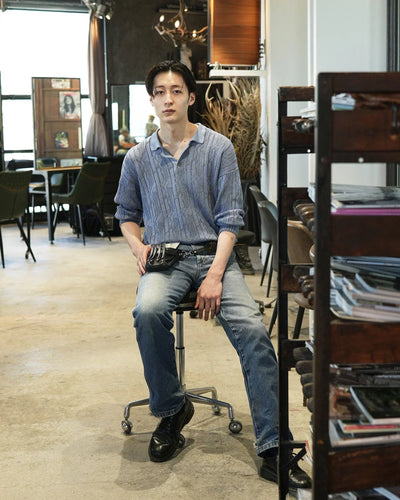
“As I entered my thirties and began to feel more like an adult, the simple act of paying for something at a shop started to feel like a small, personal ritual of dressing up.”

These words from architect Mr. Hayashi, whose life and work have taken him to many different places, stayed with us. Today, not only payments but so many aspects of daily life have been absorbed into our smartphones, with transactions taking place through invisible streams of data.
Perhaps there will come a time when we no longer need wallets at all.
And yet, his words, shaped by a thoughtful perspective and a sensitivity beyond his years, reminded us of the quiet beauty in returning to something tangible. They also made us think about what we hope REN's products can be: objects worthy of becoming part of these small, meaningful rituals.

The story of the Key Merge Wallet actually began with a casual conversation between Mr. Hayashi and a member of the REN team at a bar. During their conversation, he mentioned something he had been looking for: “I want a wallet that can hold my keys, cards, and bills, so I can carry everything together.”

At the time, Mr. Hayashi had already been using a compact combination of a key case and wallet for around eight years. As someone interested in what architecture calls “intermediate spaces,” the areas where two different functions or environments meet, a tool that brought two purposes together felt like a natural choice.
“I wanted something that didn't just keep my keys together, but also had the look and feel of a proper wallet when I held it in my hand.”
Turning that idea into a product, however, proved more difficult than expected. When the shape was made long and narrow like a key case, there was no room for coins, and the overall balance no longer worked. The position of the snap closure was adjusted repeatedly, down to the millimeter. After many rounds of trial and error, the team finally arrived at a shape with the familiar presence of a wallet.

“My driver's license, ID, credit cards, keys, and money are all in here. Because everything is together, I'm less likely to lose it, and whenever I go out, this is all I need to take. Even the way it feels in my hand just feels right.”
With all his essentials kept in one place, the wallet naturally finds a designated spot in his daily life. Wherever he goes, he can take just this one item with him and carry it with care.
 |
 |
“Another thing I like about leather is that you don't have to be too careful with it. Of course, taking good care of it is wonderful, but even the little scratches and oil marks that come with everyday use become part of its character. I like being able to use it without worrying too much, and watching it grow and change alongside me.”
Looking at Nature More Closely
Behind his appreciation for the way objects age and the quiet presence they develop over time lies a deep connection to nature, something that has shaped both his life and his approach to design.

Mr. Hayashi spent his childhood and student years in Hokkaido, and later took a leave of absence from graduate school to spend time in Finland. The clear northern air and landscapes of forests and trees helped establish a lasting principle in his life: a deep respect for nature.
“I've always wanted to bring nature into my everyday life.”

One of his current passions is epiphytic plants, particularly staghorn ferns.
“In the wild, staghorn ferns grow attached to trees. They have different types of fronds, each with its own role: some collect and retain rainwater, while others carry out photosynthesis and produce spores. Mounting them on bark brings them closer to how they grow in nature, and the forms of these tropical plants are fascinating in themselves. Their shapes can change depending on how you position the light or how you mount them.”

His interest began with more familiar houseplants, but he soon found that the varieties available at garden centers and shops were relatively limited.
“What's interesting about these plants is that there are 18 original species, and by crossbreeding them through spores, you can create new forms. It's not just about enjoying how beautiful they look. You can actually take part in the process. To me, it's a more creative way of engaging with nature.”

When we look more closely at what makes nature feel so good, we begin to discover deeper ways of appreciating it.
The beauty of wood and natural materials that he experienced firsthand while studying and living in Hokkaido and Northern Europe. The process of creating new forms by working with plants himself. And his work as an architect, engaging thoughtfully with materials and spaces.

“It's not that one is more important than another. Nature is the thread running through everything I do. The things I experience and the things I create are all connected by that one thread.”
Bringing nature into everyday life and approaching the world with curiosity and sensitivity. Allowing leather to soften and develop its own character over time, much like carefully tending and shaping a plant. His way of thinking finds a quiet expression in this one small object.